


History
The Royal United Hospital (RUH) has been providing healthcare to Bath and the wider region since the early 19th century. Over time, it has expanded to meet growing demand, with new wings and specialist units added across the site. The surgical triage unit targeted for redevelopment was originally built to manage emergency cases but had become outdated and no longer suited to modern medical requirements. Its transformation into a flexible ward space formed part of the hospital’s ongoing investment in patient care and infrastructure.
Project Overview
The scope of works required Weaver Demolition to operate with precision and adaptability, balancing demolition tasks with the need to maintain live hospital operations:
- Soft Strip: The unit was comprehensively stripped of fixtures, fittings, and redundant services to prepare for demolition.
- Internal Demolition: Partitions, floor slabs, and internal walls were removed, enabling reconfiguration of the ward layout.
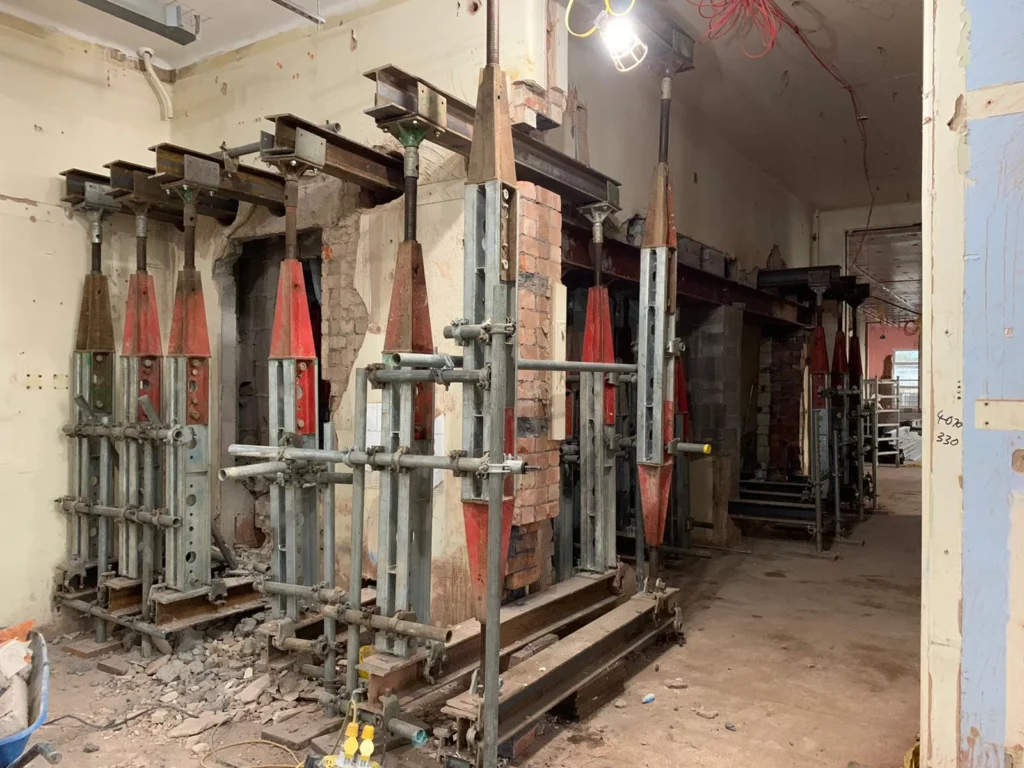
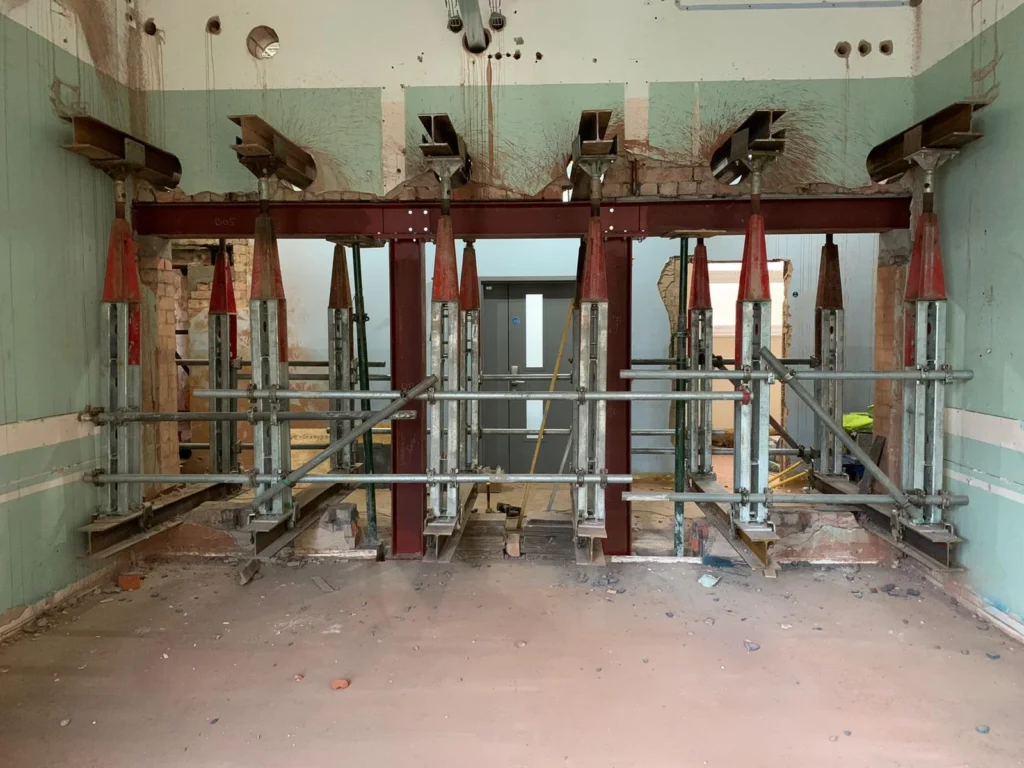
- Temporary Works and Propping: A bespoke temporary works solution was designed and installed to safeguard the structural stability of the building during alterations.
- Structural Alterations: Steelwork was fabricated and installed in-house to form new openings and support reconfigured spaces.
- Noise and Dust Control: Soundproofing systems and advanced dust suppression techniques were deployed to protect patients and hospital staff in adjacent wards.
- Just-in-Time Logistics: All materials and equipment were delivered and removed using a carefully scheduled system to minimise disruption within the live hospital campus.
Project Requirements
The client’s requirements reflected the challenges of working in a healthcare environment:
- Continuity of Care: Hospital services had to remain operational, requiring strict control of noise, dust, and vibration.
- Precision: Internal demolition and alterations had to be carefully sequenced to avoid compromising structural integrity.
- Flexibility: The contractor needed to adapt to evolving design changes throughout the programme.
- High Standards of Safety and Compliance: Health & safety, infection control, and environmental protection were paramount.

Environmental Impact
While the project was primarily internal, Weaver implemented a series of sustainable and responsible measures:
- Dust Suppression: Misting and filtration systems reduced airborne particles, protecting both workers and hospital staff.
- Material Management: Waste arisings were segregated for recycling wherever possible, reducing landfill disposal.
- Efficient Logistics: The just-in-time delivery system minimised traffic and congestion on site, lowering emissions.
Key Benefits to the Client
Weaver’s delivery provided significant benefits:
- Safe Completion in a Live Environment: The triage unit was decommissioned and reconfigured without disruption to the hospital’s critical operations.
- Integrated Steelwork Capability: By fabricating and installing temporary and permanent steelwork in-house, Weaver reduced reliance on subcontractors and shortened lead times.
- Adaptability: The team responded flexibly to design changes, ensuring progress was maintained despite evolving client requirements.
- Future-Proofed Facility: The reconfigured space now provides a modern ward with capacity to adapt to changing healthcare demands.
Project Summary
In just 18 weeks, Weaver Demolition successfully decommissioned and reconfigured a redundant surgical triage unit within Bath’s Royal United Hospital. The project involved soft strip, internal demolition, structural alterations, and installation of temporary and permanent steelwork, all undertaken within a live hospital environment. Through meticulous planning, innovative logistical solutions, and rigorous safety measures, Weaver delivered a safe, efficient, and future-ready space that will support the hospital’s vital role in serving the community.